History of l’île de Sieck
An island between land and sea
A preserved island, once home to a small community turned towards the sea, Île de Sieck now belongs to a family committed to preserving its spirit while offering guests the chance to stay here.
Set off for a timeless stay, in a landscape shaped by sea spray, silence and island memory.
Geography & toponymy
Step into a mythical land
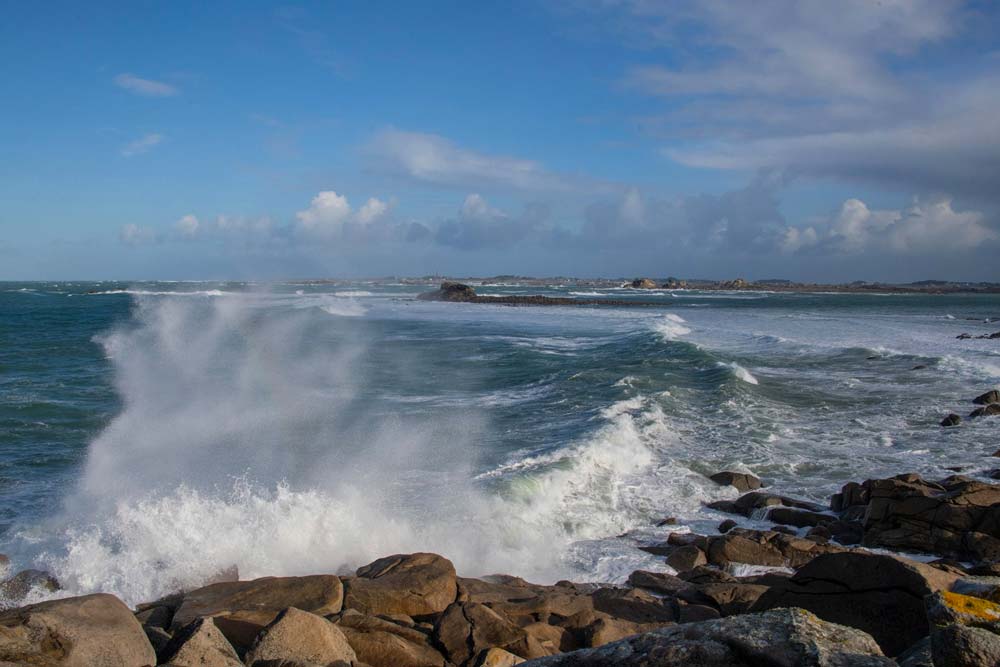
Facing Santec, Île de Sieck appears as a world apart, accessible at low tide when the sea withdraws and reveals a temporary passage. This fragile link with the mainland is part of the island’s mystery and singular character.
Its name, “Sieck”, is as intriguing as it is evocative. It may derive from Saint Hieg, a little-known saint of the early Middle Ages, suggesting an isolated place with its own customs and forgotten memories.
Sieck is a land apart, shaped by winds and tides. Here, the landscape moves between dunes, rocks and heathland, offering a raw setting deeply rooted in the identity of the northern Finistère coast.
A village turned towards the sea: fishing and sardine canning
Until the beginning of the twentieth century, the island was home to a true fishing village. A modest but lively community lived here, entirely turned towards the sea. Its inhabitants depended on coastal fishing, seaweed gathering and small-scale subsistence farming.
The island also experienced a more structured period of economic activity with the establishment of a sardine cannery. This small local industry, emblematic of maritime Brittany, bore witness to a collective organisation and know-how that have now disappeared.
The stone buildings, still visible today, carry the silent traces of that once lively period.
Island life: school and population
At its height, the island counted several dozen inhabitants, living in near self-sufficiency. This micro-community even had its own elementary school, a sign of a fully organised island life.
Children grew up to the rhythm of the tides, in an environment that was both demanding and profoundly free. The school, now gone, embodies the memory of a simple yet intensely human daily life, in which each generation contributed to the continuity of life on the island.
Ruptures and silence: war and abandonment
Like many places along the Breton coast, Île de Sieck was marked by the upheavals of the twentieth century and by the disruption brought by the Second World War. Island life gradually became more fragile.
Little by little, the inhabitants left the island, drawn away or forced by the changes of the modern world. Silence replaced activity, and the houses were gradually abandoned, leaving the island to the presence of wind and sea.
A preserved island
Today, Île de Sieck has once again become a rare and confidential place.
A private property, it now has only a few houses, carefully restored with respect for their original architecture.
This preserved character makes it a unique refuge, far from all agitation. Staying in the house on Île de Sieck means returning to a form of essential experience, in a setting of striking beauty, where history seems to surface from every stone and where luxury is defined by space, silence and time regained.
BOOKINGS — PRIVATE STAYS
A WORLD APART
Privacy and intimacy
Île de Sieck is a confidential place.
Only a few houses remain on the island today, preserving a rare atmosphere.
Staying in the house on Île de Sieck means experiencing a discreet form of luxury — the luxury of seclusion, untouched nature and a place steeped in history.
A stay on the island is not simply a trip. It is a pause.
Contact
For any enquiry, please contact: